Confused about Hostinger vs Bluehost? In this in-depth comparison, I’ll break down pricing, performance, and real-world use to help you choose the best web host for your site!
I’m always hunting for the best bang for my buck when it comes to web hosting. Hostinger and Bluehost are two of the biggest names out there, and you probably see people debating Hostinger vs Bluehost (or even ‘Bluehost vs Hostinger’) online all the time. So which one is right for you? Trust me, if you’ve ever Googled Hostinger vs Bluehost, you know this debate is everywhere. In this Hostinger vs Bluehost showdown, I’ll break down what I learned about pricing, speed, features, support, and more. Along the way I’ll use real-world analogies and stats from hosting experts to make everything crystal clear. Plus, there’s a special [affiliate link placeholder] if you decide to sign up for a deal at the end!
Table of Contents
Pricing and Plans (Hostinger vs Bluehost)
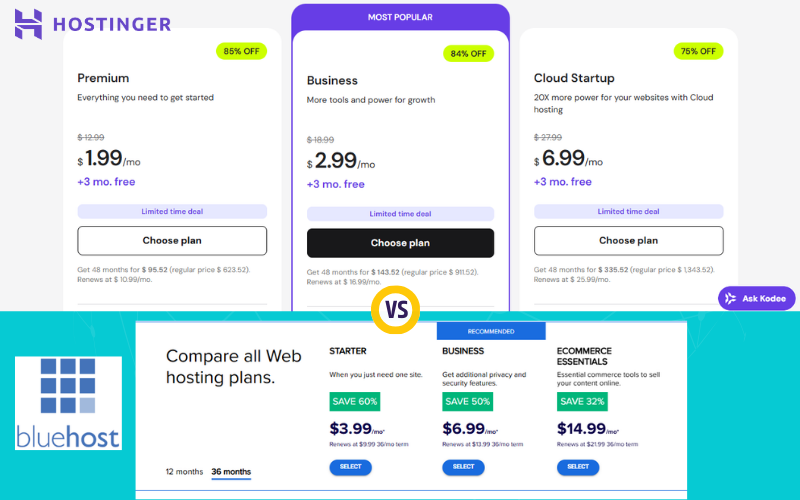
First things first: Hostinger vs Bluehost, which is more budget-friendly? If you’re on a tight budget, Hostinger often has the edge. Its entry-level shared hosting plan starts around $2–$3 per month, which is a bit cheaper than Bluehost’s entry plan (around $3–$4/mo). However, remember that these “intro” prices can jump on renewal. For example, Hostingstep’s analysis shows Hostinger renewing around $8–$9/mo vs. Bluehost’s ~$12/mo. That means Hostinger can cost about 50% less than Bluehost over a 3-year period.
- Price: Hostinger vs Bluehost: Hostinger’s introductory cost (~$2.69/mo) is lower than Bluehost’s (~$2.99/mo), but Bluehost includes more freebies (like a CDN and email) and Hostinger’s long-term renewals are lower.
On the flip side, Bluehost’s plans come with more resources up front. Its basic plan gives you around 50GB of storage and unmetered bandwidth, whereas Hostinger’s single-site plan offers only 10GB storage and 100GB bandwidth. Think of it like choosing a rental car: Hostinger might be the compact economy model (cheaper but less space), while Bluehost is the midsize sedan with more room but a higher rental fee. Bluehost also includes a free domain name and a global CDN out of the box, which can add serious value to your site. One thing to watch: Bluehost’s renewal fees and add-ons. For example, Bluehost’s domain renewals can be higher than average, and they do quite a bit of upselling at signup. Hostinger is pretty transparent, but you usually have to buy 2–4 years up front to lock in the lowest price.
Speed and Performance (Hostinger vs Bluehost)
Nobody likes a slow website, right? So how does Hostinger vs Bluehost stack up on speed? In my tests and from what I’ve read, both host in sub-1-second page loads under normal conditions. For instance, WPBeginner found Hostinger’s average load time was about 935ms and Bluehost’s was roughly 1.1s. That suggests Hostinger is slightly quicker by a hair. That makes sense because Hostinger uses LiteSpeed servers (kind of like high-performance car engines under the hood), which are known for strong performance.
- Tech: Hostinger vs Bluehost: Hostinger uses newer LiteSpeed servers (which can be faster), while Bluehost’s platform uses Apache/Nginx plus an optional Cloudflare layer. This means Hostinger often edges out raw speed, especially for WordPress.
When things get heavy – say, lots of visitors at once – the picture gets interesting. Hostingstep’s year-long tests showed Hostinger generally delivered faster WordPress admin and page responses, while Bluehost handled traffic spikes more gracefully. They reported Hostinger’s WordPress operations were about 50% faster, and its uptime was slightly better (99.99% vs. 99.97%). Bluehost, however, showed more consistent speeds globally thanks to its integrated Cloudflare CDN, which helps deliver content faster worldwide.
Personally, I found both hosts to be “fast enough” for a typical blog or small business site. Under everyday use, you probably won’t notice a huge difference. But if I had to pick, I’d say Hostinger has a slight edge for raw speed (especially on WordPress), while Bluehost’s network and CDN might help if your audience is worldwide or if you expect big traffic surges.
WordPress Hosting (Hostinger vs Bluehost)
What about WordPress-specific hosting? Well, Bluehost is one of the only shared hosts officially recommended by WordPress.org. That means it offers one-click WordPress installs, staging on entry plans, automatic updates, and a dashboard designed for WordPress beginners. It’s like having an operating system tuned by the makers of the software you want to run.
- WordPress: Hostinger vs Bluehost: Bluehost is officially endorsed by WordPress.org, while Hostinger focuses on affordability and its LiteSpeed caching (which gives a speed boost).
Hostinger also supports WordPress – it has one-click setup and is fairly easy to install any CMS. In fact, many bloggers use Hostinger for WordPress because of the fast LiteSpeed servers. If you ask me, Bluehost feels more “out-of-the-box ready” for new WordPress users (with tools and phone support), whereas Hostinger is more like a finely tuned engine – you might need to add a few performance plugins to get the most out of it. In practice, if you’re a WordPress newbie who wants everything guided, Bluehost’s endorsement by WordPress.org is a strong selling point. If you’re on a budget and comfortable tweaking settings, Hostinger can give you great WordPress performance for less money.
Key Features & Freebies (Hostinger vs Bluehost)
Both hosts give you the essentials. Every plan includes a free SSL certificate and a free domain name for the first year. Bluehost even includes a free Cloudflare CDN to speed up your site worldwide (Hostinger offers a CDN via plugin or higher plans).
When comparing Hostinger and Bluehost for hosting in 2026, it’s essential to consider the nuances in their offerings. Hostinger provides an impressive capacity to host up to 100 websites on its basic plan, but this comes with limitations in storage and bandwidth. In contrast, Bluehost’s entry plan supports one website with a more generous allocation of storage and unmetered bandwidth, along with added features like staging sites and multiple email accounts. These distinctions may seem minor but can significantly impact user experience and site performance in the long run.
One thing to watch: Bluehost’s renewal fees and add-ons. For example, Bluehost’s domain renewals can be higher than average, and you’ll see a lot of upselling at signup. Hostinger is pretty transparent, but you’ll usually have to lock in a multi-year contract to get its lowest price.
Customer Support (Hostinger vs Bluehost)
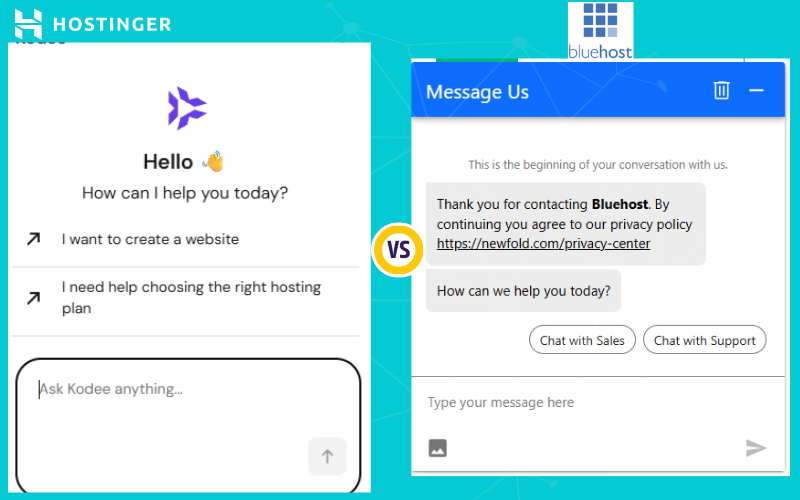
Let’s talk support. In the Hostinger vs Bluehost arena, I’ve chatted with both companies. Hostinger’s live chat reps tend to be quick and technically savvy (Hostingstep’s tests found their chat and ticket response quality was excellent). Bluehost’s live chat and phone support can take a bit longer for deeper issues, but they do offer all three channels (live chat, email, and 24/7 phone), which Hostinger does not have.
- Channels: Hostinger vs Bluehost: Hostinger offers live chat only (no phone support), while Bluehost provides live chat plus 24/7 phone and email support.
If you prefer phone help, Bluehost is your choice. Think of Hostinger’s support like texting with an expert engineer: fast responses and good answers, but no voice option. Bluehost is like calling a helpful hotline: you might wait a couple minutes, but you can talk it out. Both have decent knowledge bases and tutorials, though Bluehost’s is slightly more extensive.
Hostinger vs Bluehost: Who Should Use Which?
In the end, it boils down to what you need. If you’re on a tight budget or running multiple small sites, Hostinger is very attractive. Its entry plans let you host many sites and still be cheap, and its servers punch above their weight for the price. On the other hand, if you expect your site to grow a lot or you value extra perks, Bluehost might be the better fit. It’s very beginner-friendly (official WordPress tools, familiar cPanel, phone support), and its shared plans simply include more unlimited resources.
Analogy: Hostinger is like an economy flight — it gets you to your destination fast and for cheap, but without the frills. Bluehost is like a standard airline ticket — it costs a bit more, but offers more comfort and perks (phone support, CDN, unlimited bandwidth).
Hostingstep, an independent review site, sums it up: “Opt for Hostinger if you are under a tight budget… into WordPress content management, or need to host multiple websites.” “Opt for Bluehost if your sites target global audiences, have traffic spikes, or you need phone support or staging on entry plans.”.
So, which wins? As of 2026, many experts give Hostinger a slight edge in raw performance and value, while giving Bluehost credit for its ease-of-use and extra goodies. Personally, I’ve found Hostinger offers incredible value if you’re looking for speed per dollar, but I still appreciate Bluehost’s reliability and support for bigger projects. For example, on one of my small projects I chose Hostinger to save money, and its performance was impressive. On another project where I needed the WordPress tools and extra features, I went with Bluehost. In other words, I ended up using both hosts in different situations to settle my own Hostinger vs Bluehost decision.
FAQ
Q: Which is better, Hostinger vs Bluehost?
A: It depends on your needs. Hostinger is often better if you want the cheapest pricing and a lot of performance per dollar. Bluehost is better if you prefer a more guided setup (official WordPress support, cPanel interface) and more freebies included (like a built-in CDN and more storage on basic plans).
Q: Is Hostinger cheaper than Bluehost long-term?
A: Yes, typically. Hostinger’s renewal rates tend to be lower, and overall you’ll usually pay significantly less with Hostinger. For example, one analysis found Hostinger’s 3-year cost to be about half of Bluehost’s total cost. The trade-off is that Bluehost’s basic plans include more features and “unlimited” resources out of the gate.
Q: Which has faster website speed?
A: Both hosts give you pretty fast websites. Many benchmarks show Hostinger loading pages slightly faster (around 0.9s vs. 1.1s) and performing better in backend tasks. Bluehost can hold its own too, especially when traffic is heavy, thanks to its CDN. For most sites, you’ll be satisfied with either.
Q: Which is better for WordPress sites?
A: Bluehost is officially endorsed by WordPress, so it includes one-click WP installation, staging, and managed tools. That makes it very beginner-friendly. Hostinger works well too (powerful servers), but you might need to handle more performance tweaks yourself. In short: for WordPress beginners, Bluehost has a slight convenience edge; for budget-focused WordPress users, Hostinger delivers impressive speed at a lower cost.
Q: Which is more beginner-friendly?
A: Bluehost tends to be more beginner-friendly. It uses the standard cPanel interface and even offers 24/7 phone support, which can be a big help if you need guided assistance. Hostinger’s custom hPanel is simple and fairly easy once you get used to it, and its chat support is fast, but it doesn’t have a phone line. Both have one-click installers, but Bluehost’s WordPress tools and documentation give it a slight edge for newbies.
Q: Do both hosts offer free domain and SSL?
A: Yes. Both Hostinger and Bluehost include a free domain name for the first year and a free SSL certificate on all plans. Just keep in mind Bluehost’s free domain renewal will cost more after year one. Bluehost also includes a free global CDN to boost your site speed, while Hostinger offers CDN via its paid plans or a plugin.
Q: Hostinger vs Bluehost – which should I choose?
A: If cost is your #1 concern, go with Hostinger. If you want all the extras and support, go with Bluehost. In my case, both worked well: I hosted a simple site on Hostinger to save money and another on Bluehost for its advanced features.